
Imagine your family e-commerce shop is thriving, but suddenly, nobody can access the admin dashboard because the passwords were only in your head. It's a nightmare scenario that many independent sellers face. Effective succession planning for a family-run online business is about more than just picking a successor. It's about securing your digital keys and protecting everything you've built from technical or legal lockouts.
You've worked hard to grow your brand. It's natural to worry about family conflict or the business collapsing if you're no longer at the helm. With UK inheritance tax rules shifting, such as the £2.5 million cap on Business Property Relief starting in April 2026, the financial stakes are high. You need a transition that's tax-efficient and free from internal friction. This guide shows you how to protect your digital legacy and ensure your loved ones can take the reins with confidence.
We'll walk through securing your domains, navigating HMRC thresholds, and setting clear roles for a seamless handover. Let's get your digital house in order for the next generation.
Key Takeaways
- Audit your digital footprint, including domains and hosting, to ensure your successors have immediate access to vital marketplace accounts.
- Transition family members into leadership roles through a structured merit-based programme that focuses on digital literacy and strategy.
- Master the 2026 tax landscape to manage Business Property Relief caps and ensure a tax-efficient transfer of your e-commerce assets.
- Learn modern methods for valuing your digital venture to create a clear roadmap for succession planning for a family-run online business.
- Reduce the technical burden on the next generation by leveraging platform tools designed to streamline operations and business longevity.
What is Succession Planning for an Online Family Business?
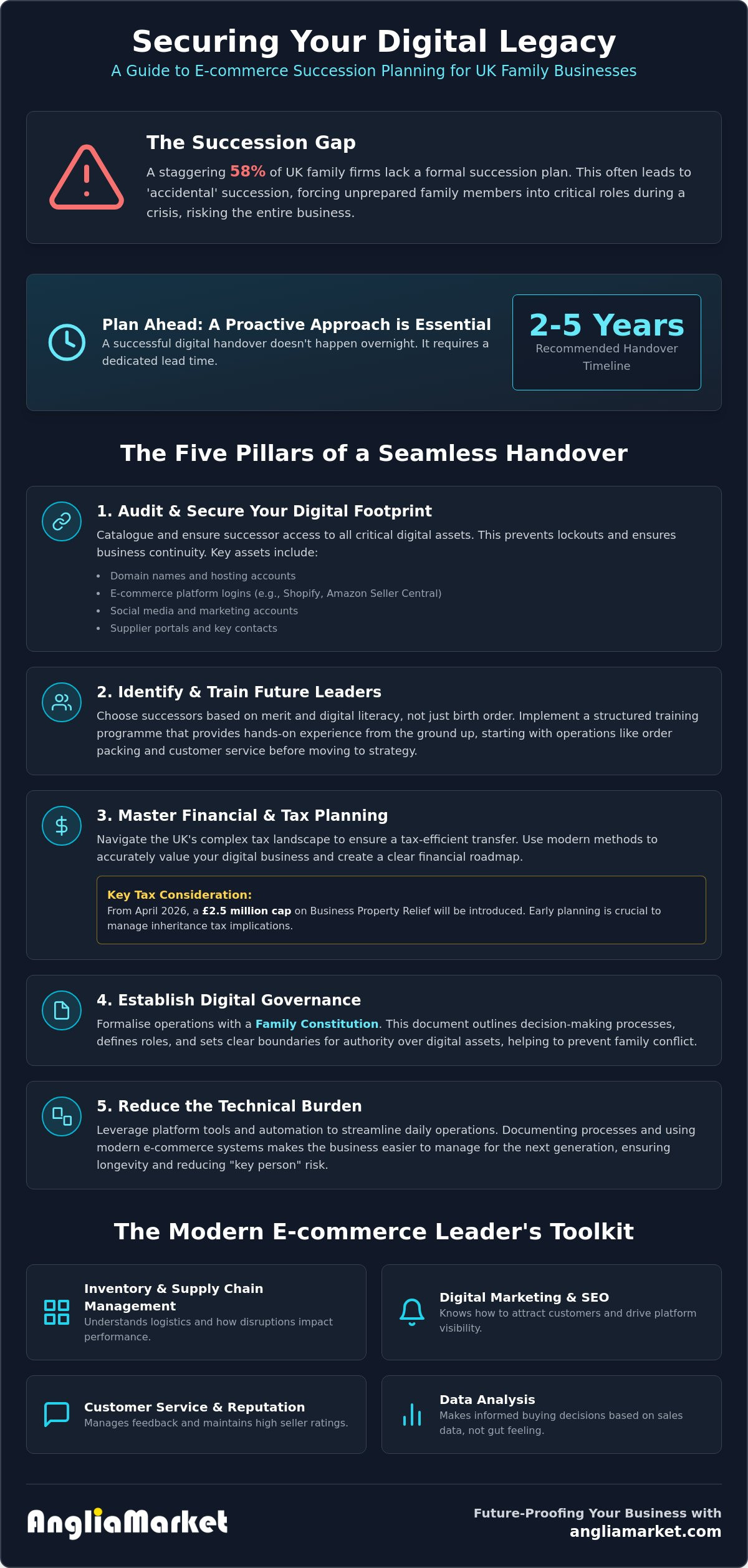
Succession planning in a digital context involves more than just drafting a legal will. It's a comprehensive strategy for transferring both the ownership and the complex daily operations of a digital storefront. In the 2026 UK economy, where digital records and platform compliance are strictly monitored, this process ensures your business survives your departure. Currently, 58% of UK family firms lack a formal plan. This often leads to "accidental" succession, where family members are forced into roles they aren't prepared for, often during a period of grief or crisis.
It's vital to distinguish between passing on equity and managing the shop's daily pulse. You might leave company shares to all your children, but only one might have the technical skill to manage logistics and marketplace algorithms. For an e-commerce venture, revenue is often platform-dependent. If your account health or seller rating drops during a messy transition, the business value can evaporate overnight. This makes succession planning for a family-run online business a technical necessity as much as a legal one.
The Importance of Early Planning in E-commerce
Digital transitions don't happen in a month. You need a two-to-five-year lead time to document processes and train successors effectively. This timeline reduces "key person" risk, which is high when a single founder holds all the passwords and supplier relationships. Starting early allows you to mentor your successor whilst protecting your vendor reputation and customer trust. A slow handover ensures that customers and platform algorithms don't notice a change in service quality or fulfillment speed.
Legacy vs. Liquidity: Determining Your Family Goals
Decide early if the goal is to keep the business in the family for decades or to prepare it for a sale. This choice dictates your entire strategy. You'll need to balance the needs of family members who work in the business against those who don't. If some children aren't involved in daily operations, you might use other assets to balance their inheritance. Aligning these decisions with your lifestyle and retirement goals ensures you can step away with the liquidity you need whilst the business remains stable under new leadership. For those planning for their later years, it may also be helpful to explore Hourly and Daily Home Care Service Fees to see how professional support can be factored into a long-term financial plan.
Identifying and Training the Next Generation of Digital Leaders
Finding the right person to lead your digital shop is a critical step in succession planning for a family-run online business. Traditionally, family firms might look to the eldest child to take over. In e-commerce, this approach is risky. You need a leader with high digital literacy and the ability to adapt to rapid platform changes. Evaluate your family members based on their merit and technical aptitude rather than birth order. This ensures the business stays competitive in a fast-moving market.
Consider an apprenticeship model for your potential successors. A successor shouldn't start as a director. They should begin by packing orders and handling basic customer queries. This hands-on experience builds a deep understanding of the business from the ground up. Over time, they can transition into managing marketplace strategy and vendor relationships. This gradual progression helps them earn the respect of other staff members whilst learning the technical side of the trade.
Managing the challenges of a family business often means dealing with complex emotional dynamics. Working with siblings or children in a high-pressure retail environment can lead to friction. If a family member lacks interest or skill, don't force it. It's often better to hire non-family management for specialised digital roles, such as SEO or complex data analysis. This keeps the business professional whilst protecting family relationships.
The E-commerce Skill Set for Successors
A successor needs a specific toolkit to thrive. They must understand inventory management and how supply chain disruptions impact your shop's performance. Mastering digital marketing and customer service is equally important. They should know how to maintain high seller ratings and manage feedback effectively. Finally, they need to be comfortable analysing sales data. Making informed buying decisions based on trends rather than gut feeling is what keeps a shop profitable.
Establishing Digital Governance
Formalise your operations with a Family Constitution. This document outlines how decisions are made and who has final authority over digital assets. Set clear boundaries to prevent business talk from dominating family time. Organise regular strategy summits where all stakeholders, even those not working in the shop, are updated on performance. This transparency builds trust and keeps everyone aligned with the long-term goals. If you're ready to start professionalising your family venture, you can apply to sell online and test your team's readiness on a managed platform.
The Digital Handover: Securing Assets and Platform Access
Digital asset ownership is often the single point of failure in e-commerce transitions. If you lose access to your primary domain or marketplace account, the business stops instantly. You can't just hand over a physical set of keys. You're handing over a complex web of digital permissions. This technical risk makes a practical guide to business succession planning essential for modern sellers. You must ensure every "digital key" is accounted for before the handover begins.
Audit your digital footprint immediately. Many founders use personal email addresses to register domains or hosting services. When you step down, those personal accounts might go with you. Succession planning for a family-run online business must include moving these contracts into the company's name. This ensures the successor has legal standing to manage the accounts. Moving the "Seller Profile" to the successor is a formal process. It involves updating legal entity details with the platform provider to avoid account suspension.
Centralise everything in a "Digital Vault". Use a business-grade password manager to store credentials for social media, ad accounts, and marketplace dashboards. This simplifies Multi-Factor Authentication (MFA) management. If the MFA is tied to your personal mobile phone, the business is paralysed when you aren't available. A shared, secure vault allows for a smooth transition without compromising security protocols.
A Checklist for Digital Asset Transfer
- Domain Names: Confirm registration is in the company name, not a personal email.
- Social Media: Ensure full admin access to profiles and advertising accounts.
- Marketplace Profiles: Transfer ownership of marketplace accounts like Anglia Market to the new primary user.
- Hosting and Backend: Documentation for server access and third-party software integrations.
Managing Supplier and Vendor Relationships
Introduce your successor to key suppliers early to maintain trust and existing credit terms. When updating bank details or payment gateways, do it carefully. Sudden changes can trigger fraud alerts and freeze your cash flow during the transition. Document the "unwritten rules" of your trade partnerships. These are the small details about discounts, seasonal lead times, or delivery preferences that aren't always in the formal contract. These relationships are the backbone of your margins.
Financial Valuation and Tax Efficiency for UK Family Businesses
A successful transition relies on a transparent balance sheet. Before you hand over the reins, you must "clean the books" by separating personal expenses from business costs. This process is essential for accurate valuation and tax compliance. In 2026, valuing an online business usually involves a multiple of your annual profit, often between two and five times your Seller's Discretionary Earnings. However, your digital assets, like proprietary software or a high-performing domain, can push this figure higher. Accurate records make succession planning for a family-run online business much smoother for everyone involved.
Tax efficiency is the next hurdle. UK Inheritance Tax (IHT) rules are strict; the standard rate is 40% on estates above the £325,000 nil-rate band. Gifting shares to family members can trigger Capital Gains Tax (CGT). For the 2026/27 tax year, the annual exempt amount is £3,000. If the disposal qualifies for Business Asset Disposal Relief, the CGT rate is 18%. Planning these transfers early helps you utilise these allowances effectively without creating a sudden tax burden for your successors.
Maximising Business Relief (BR) for E-commerce
Business Relief is a powerful tool for reducing IHT. From April 2026, 100% relief is capped at a combined £2.5 million per individual for qualifying assets. To qualify, your shop must be a "trading" entity. If you hold too much "excess cash" that isn't being used for business operations, HMRC might classify part of the venture as an investment, which doesn't qualify for the same relief. Always seek advice from a UK-based tax specialist to ensure your structure meets the 2026 requirements. To see how professional marketplace tools can help you track the data needed for these valuations, explore our vendor resources.
Valuing your Digital Intellectual Property
Your business value isn't just in your warehouse. Your customer database and mailing lists are significant assets. Marketplace reviews and a strong brand reputation also carry financial weight. When calculating value, account for your inventory model. A "just-in-time" model might show lower physical asset value but higher agility and cash flow. Ensure your valuation includes your stock-on-hand, valued at the lower of cost or net realisable value, to give your successor a realistic starting point.
Future-Proofing: How Anglia Market Supports Business Longevity
A major hurdle in succession planning for a family-run online business is the technical debt often left behind by a founder. If your business relies on a custom-built website with complex code, your successor might struggle to maintain it without expensive external help. Using a managed marketplace removes this technical burden. The platform handles security updates, server maintenance, and transactional safety. This allows your family to focus on retail strategy rather than troubleshooting software issues. It's a practical way to ensure the business remains operational during a leadership change.
Automation is your best friend when preparing a handover. Platform tools that sync inventory and manage customer service queries reduce the daily workload for new managers. By automating repetitive tasks, you make the business more "turnkey" for the next generation. A professional storefront on a trusted marketplace builds a brand that exists independently of your personal identity. This makes it easier for customers to trust the new leadership, as the shopping experience remains consistent and reliable regardless of who is behind the dashboard.
Simplifying Operations for the Next Generation
Don't leave your successors to guess what's working. Marketplace analytics provide clear data on sales trends and customer behaviour. This data-driven approach helps new managers make confident buying decisions from day one. Creating detailed Anglia Market profiles ensures your brand voice stays the same whilst the person managing it changes. You also reduce overheads by using the platform's existing infrastructure, such as integrated payment gateways and marketing tools, which would be costly to manage independently.
Building a Multi-Generational Brand
Transforming a "hobby shop" into a professional family legacy requires the right environment. Being part of a community of UK vendors helps your successors stay ahead of retail trends and platform updates. This support network is invaluable for younger family members who are still finding their feet in the industry. It's time to move beyond daily survival and start thinking about your long-term impact on the regional economy. You're building a business that can support your family for decades.
Long-standing retailers like the Belfast Bed Superstore exemplify this journey, showing how a family-run business can maintain its reputation for quality and service while successfully transitioning through different eras of retail.
You've built something worth protecting. Invite your family members to start selling online today to begin their practical training in a controlled, supportive environment. Effective succession planning for a family-run online business is a journey, not a single event. Take the first step by reviewing our testimonials to see how other independent sellers have professionalised their ventures. Start planning for your family's future success now.
Secure Your Digital Legacy Today
Transitioning an e-commerce venture requires a precise blend of technical security and clear communication. You've learned how to audit your digital footprint, from domain ownership to marketplace credentials. You've also seen how early financial preparation helps you navigate the 2026 UK tax landscape and Business Relief caps with confidence. Effective succession planning for a family-run online business isn't just about your eventual exit; it's about building a robust structure that thrives under new leadership.
Managed platforms simplify this journey by removing the technical burden from your successors. Anglia Market is specifically designed for UK SMEs, offering simple vendor management tools that make daily operations transparent and handovers effortless. It's a platform already trusted by family-run businesses across the United Kingdom to provide a stable, professional environment for long-term growth. Join Anglia Market today to build your family’s digital legacy and ensure your shop remains a cornerstone of your family's success for generations to come. Your hard work deserves a future as bright as its beginning. Start your transition plan today.
Frequently Asked Questions
What is the most common mistake in family business succession?
The most common mistake is failing to document "digital keys" like passwords and Multi-Factor Authentication settings. If these are only in your head, the business stops the moment you aren't there. Succession planning for a family-run online business must prioritise a technical audit. This ensures your successors aren't locked out of marketplace accounts or domain hosting during a critical transition period.
Do I need a solicitor for an online business succession plan?
You absolutely need a solicitor to handle the legal transfer of shares and update your will. Online businesses involve complex intellectual property and platform contracts that require formal legal standing. A solicitor ensures your plan is legally binding under UK law. This prevents future disputes amongst family members and ensures the transition of ownership is recognised by HMRC and your bank.
Can I pass my marketplace seller account to my children?
You can usually pass your account to your children, but you must follow the platform's formal transfer process. Simply sharing your login details is risky and can trigger security freezes. You need to update the legal entity and contact information with the provider. This maintains your hard-earned seller rating whilst ensuring the new leadership has full legal authority over the storefront and its funds.
How much is my online family business worth in 2026?
Most online shops are valued at a multiple of their annual profit, often between two and five times. Your digital IP, such as your mailing list and marketplace reviews, adds significant weight to this figure. In 2026, buyers also look at your inventory agility and brand consistency. Professional records are vital to prove your shop's worth to successors or potential external buyers.
What happens to the business if I die without a succession plan?
If you die without a plan, your business assets are distributed according to UK intestacy laws. This often leads to long delays in accessing bank accounts and digital dashboards. Without clear instructions, family members may struggle to manage daily logistics. The business value could drop rapidly if orders aren't fulfilled or if platform algorithms penalise the shop for inactivity during the legal probate period.
Is an online business eligible for Business Relief in the UK?
Yes, online trading businesses generally qualify for Business Relief from Inheritance Tax. From April 2026, 100% relief is capped at a combined £2.5 million per individual. To stay eligible, your venture must be a "trading" entity rather than an investment vehicle. Holding too much excess cash in the business can sometimes jeopardise this relief, so regular reviews with a tax specialist are essential.
How do I handle family members who don’t want to be involved in the shop?
You should use other estate assets, such as property or life insurance, to balance the inheritance for family members who aren't involved in the shop. Forcing uninterested relatives into operational roles often leads to business failure and family friction. You might also consider offering them non-voting shares. This allows them to benefit from the business's success without having a say in daily marketplace management.
When should I start talking to my family about succession?
Start talking to your family at least two to five years before your planned retirement. This lead time is necessary for effective succession planning for a family-run online business. It gives you space to mentor your successor and test their technical literacy. Early conversations also help identify who is actually interested in the work, preventing last-minute panic and ensuring a smooth handover of your digital legacy.

Here to help — ask anything
If you have any questions regarding this disclaimer or any of our policies, please contact Anglia Market via the contact page on our website, by email using the address provided on the site, or by phone on 0333 772 2593