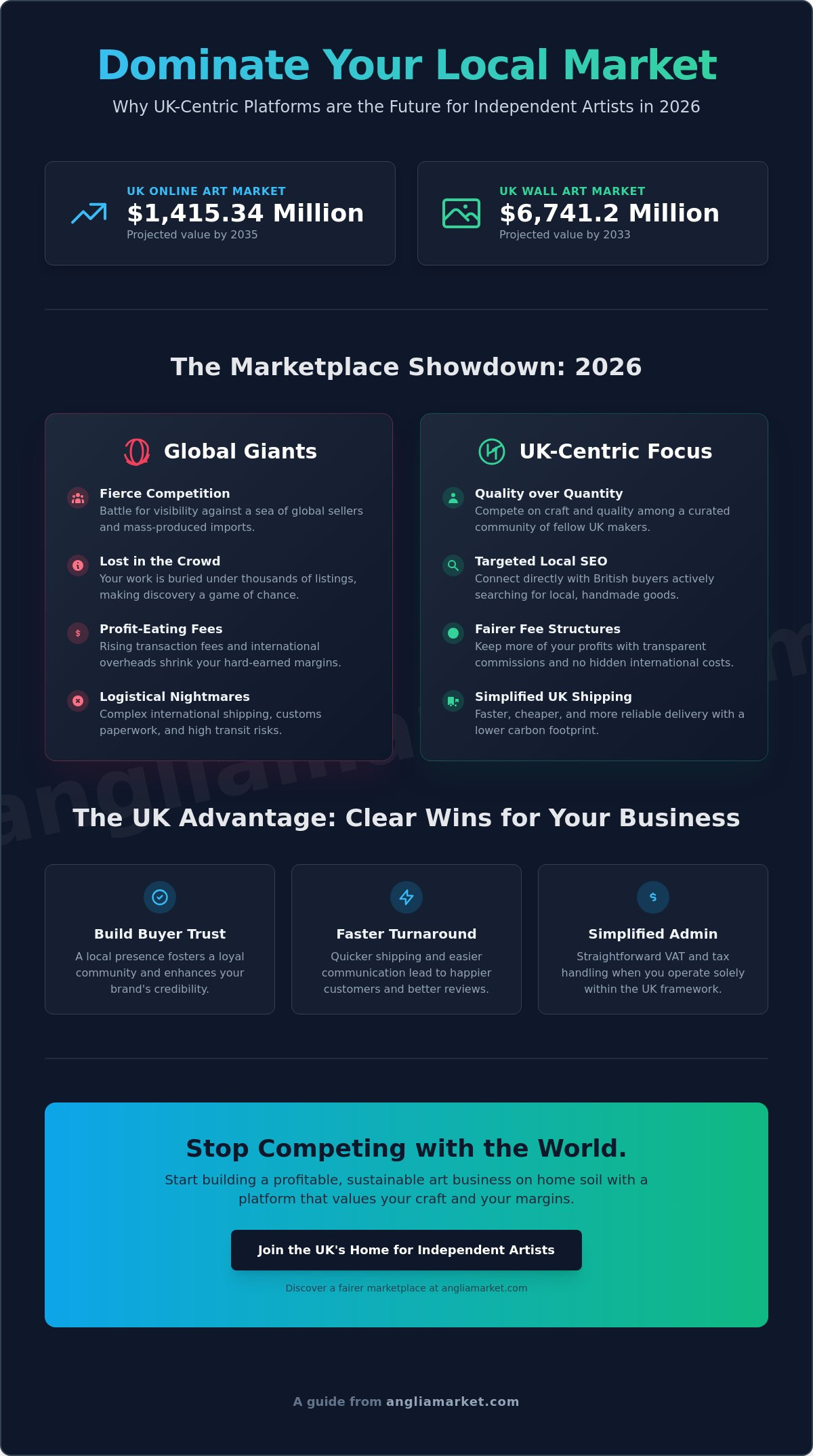
What if the secret to scaling your creative business in 2026 isn't reaching every corner of the globe, but dominating your own backyard? The UK online art market is booming. It's projected to reach $1,415.34 million by 2035. However, finding the right online marketplace for independent artists uk is now a major challenge. You've likely felt the sting of rising transaction fees and new regulatory operating costs that eat into your margins. It's frustrating. Profits vanish into international overheads. Shipping is a headache. You're tired of being lost in a massive global crowd where your work is buried under mass-produced imports.
Finding a platform that respects your margins and connects you with loyal British buyers is the priority. This guide helps you choose a UK-centric marketplace with fair fees and simplified shop management. We'll compare the latest 2026 commission structures and show you how to maximise your earnings. Discover how to stop competing with the world and start building a profitable, sustainable art business on home soil. Let's find your perfect platform.
Key Takeaways
- Distinguish between curated and open platforms to find the ideal digital home for your creative work.
- Evaluate 2026 fee structures to select an online marketplace for independent artists uk that maximises your take-home pay.
- Overcome the biggest hurdles for sellers, from effective marketing tactics to ensuring safe transit for fragile items.
- Follow a practical five-step checklist to register your business and build a professional shop that converts browsers into buyers.
- Learn how UK-centric marketplaces provide better visibility and support for independent creators compared to massive global sites.
What is an Online Marketplace for Independent Artists in the UK?
An online marketplace for independent artists uk is a digital bridge. It connects local creators directly with British buyers. Think of it as a functional evolution of the online art gallery. These platforms handle the technical heavy lifting. They provide the storefront, payment processing, and traffic. This lets artists focus on their craft while the platform manages the commercial side. Third-party vendors are now the engine of the UK creative economy. They bring niche styles and handmade quality to a wider audience than a physical shop ever could.
Marketplaces usually follow one of two models. Curated platforms, such as Saatchi Art, act as gatekeepers. They review applications and select specific artists to maintain a certain style. Open marketplaces, like Anglia Market, are more inclusive. They empower a wider range of independent enterprises. These platforms provide tools for small businesses to sell everything from fine art to unique home and garden pieces. In 2026, being a vendor isn't just about selling a product. It's about participating in a local economy that values craft over mass production.
2026 is the year of the local maker. British shoppers are moving away from mass-produced imports. They want items with a story and a traceable origin. The UK wall art market is projected to reach $6,741.2 million by 2033. This growth is fueled by independent sellers who offer the variety and authenticity that big-box retailers lack. By using a domestic platform, you position your brand where the modern consumer is already looking.
The Evolution of the UK Art Market
Physical galleries were once the only path to success. Today, digital-first storefronts are the primary choice. The market has changed. It's no longer just about expensive investment pieces for the elite. There's a huge demand for "Art for the Home." UK consumers now prioritise supporting local businesses. They want to know where their art comes from. The transition to digital has democratised the industry. You don't need a London agent to find buyers in Manchester or Edinburgh. A well-managed shop profile allows you to compete on quality and service rather than just a massive marketing budget.
Key Benefits of Selling Locally
Selling within the UK provides clear practical wins. Shipping is faster and more reliable. Customers appreciate the reduced carbon footprint of domestic transit. It also simplifies your admin. Handling VAT and taxes is straightforward when you stay within the UK framework. Building a local presence on an online marketplace for independent artists uk creates trust. This domestic focus often opens doors to physical pop-up events and local collaborations. You aren't just a username on a global site; you're a British business growing within a loyal community.
Comparing the Best Platforms for UK Artists in 2026
Choosing an online marketplace for independent artists uk requires a balance between reach and revenue. Global giants offer a massive audience, but they often leave creators feeling like a small fish in a vast, noisy pond. For artists working in mixed media, textiles, or functional pieces, these massive sites can be overwhelming. The competition is fierce. You aren't just competing with other UK makers; you're often competing with mass-produced items from across the globe. Discovery becomes a lottery rather than a meritocracy.
Visibility is significantly better on UK-centric platforms. Local SEO targets British buyers specifically. When a customer in Bristol searches for "handmade ceramic vase," a domestic platform prioritises local results. This local focus aligns with the Creative Industries Sector Vision, which highlights the importance of domestic growth for independent creators. Managing a storefront should be fast. You want more time in the studio and less time in the back-office. Efficient platforms provide modular tools that simplify inventory management and order processing.
Global Giants vs. UK-Centric Marketplaces
Many global platforms focus on international prestige. They promise collectors in dozens of countries. This sounds great until you face international shipping logistics and customs paperwork. For many UK SMEs, the complexity isn't worth the hassle. Local buyers have specific expectations. They want reliable delivery and easy communication. A UK-centric marketplace simplifies this. It facilitates a direct connection between the maker and the local consumer. This builds a community-oriented brand rather than a faceless transactional shop.
Understanding Fee Structures and Commissions
Fees can make or break your business. Global platforms have complex layers that eat into your margins. In 2026, the costs are higher than ever. Look at the current landscape for major art-specific players:
- Artfinder: Commissions range from 40% to 45% depending on your chosen subscription plan.
- Saatchi Art: A flat 40% commission on original artworks.
- Major Global Sites: Several large marketplaces have introduced new UK-specific regulatory charges, such as the 0.48% fee effective from June 2026, on top of standard transaction and payment fees.
Hidden costs add up. International currency conversion and customs duties for global sales further reduce your take-home pay. UK-based platforms often offer lower fees and transparent pricing. This means more profit stays in your pocket. If you're ready to grow without the global headache, it's worth exploring how to sell online via a domestic platform. Higher margins allow you to reinvest in better materials or local marketing.
The Hidden Challenges of Selling Art Online (and How to Solve Them)
Making art is the easy part. Selling it is where the real work begins. Many creators struggle because they're artists, not marketing experts. This is a common hurdle when using an online marketplace for independent artists uk. You need to bridge the gap between your studio and the customer's living room. Professionalism starts with how you handle enquiries. Respond quickly. Be clear about your process. A helpful tone can turn a casual browser into a repeat customer.
High-quality photography is your most powerful tool. In a digital environment, the buyer can't touch the canvas or feel the texture of a ceramic bowl. Clear, well-lit photos from multiple angles are essential. They reduce hesitation and build immediate confidence. Use natural light. Show the scale of the piece by placing it in a domestic setting. This helps buyers visualise how the work will look in their own home.
Marketing Your Storefront Without Burnout
Don't try to do everything at once. You'll burn out. Instead, leverage the built-in tools of your chosen platform. Participating in site-wide promotions can significantly boost your visibility without extra cost. Social media is great for driving traffic, but the marketplace should do the heavy lifting for discovery. Use Instagram or Pinterest to show your behind-the-scenes process. This builds a connection that goes beyond the transaction.
Trust is the currency of the internet. Encourage buyers to leave feedback after a successful sale. Positive testimonials act as social proof. They show potential customers that you're a reliable professional who delivers on promises. Feature these reviews prominently. They are often the final nudge a buyer needs to complete a purchase.
Logistics and Fulfillment for Independent Sellers
Shipping fragile work across the UK is a major logistical challenge. One broken frame can ruin your profit and your reputation. Investing in high-quality packaging is non-negotiable. Use double-walled boxes and plenty of eco-friendly void fill. Choose reliable UK couriers who have a good track record with delicate goods. Avoid budget services if your work is high-value. Set clear shipping policies on your storefront to manage buyer expectations. State your dispatch times clearly. This prevents frustration and keeps your rating high.
Most modern platforms offer tools to automate order tracking. Use them. It reduces the number of status enquiries and keeps your customer service efficient. Handling returns is also part of the job. Have a clear, fair policy in place. It protects you and gives the buyer peace of mind. A smooth returns process actually builds long-term loyalty. Customers are more likely to buy again if they know you're easy to deal with if something goes wrong.
5-Step Checklist: Launching Your UK Art Business
Launching your shop on an online marketplace for independent artists uk is a strategic move for any creator. It requires more than just uploading a few photos. You need a clear plan to stand out. Follow this five-step checklist to build a professional foundation for your creative business in 2026.
- Step 1: Legal Registration. Register as a sole trader or a limited company. Most independent makers start as sole traders because it's the simplest path. You must register with HMRC if your annual gross trading income is over £1,000.
- Step 2: Curate Your Range. Don't list every experiment. Choose an initial product range that creates a cohesive shop look. A signature style helps buyers recognise your brand instantly.
- Step 3: Build Your Profile. Set up a complete vendor profile. Include a compelling brand story. Explain your process and what makes your work unique. People buy from people they trust.
- Step 4: SEO Optimisation. Write product titles and descriptions for UK search intent. Use terms like "handmade in Britain" or "original UK wall art." Focus on clarity and keywords.
- Step 5: Plan for Growth. Implement a strategy for repeat business. Use tools like referral discounts or automated follow-ups to keep customers coming back.
Success doesn't happen overnight. It's the result of consistent effort and professional presentation. If you're ready to reach a local audience, apply to sell on Anglia Market and start your journey today.
Legal and Tax Readiness for UK Sellers
Admin is a necessary part of growth. You need to stay compliant with HMRC requirements. As of 2026, the VAT registration threshold for UK businesses is £90,000 in taxable turnover over a rolling 12-month period. If your sales drop, the deregistration threshold is £88,000. Don't forget insurance. Public liability insurance is vital if you ever sell at physical pop-ups alongside your digital shop. Always keep your customer data secure to remain GDPR compliant. It protects your business and your buyers.
Optimising Your Digital Shopfront
Your descriptions must do the talking. Focus on benefits over features. Instead of just listing "oil on canvas," describe how the colours brighten a modern living room. SEO for artists is about specificity. Use keywords like "handmade UK" or "original art London" to capture local searches. Integrating your shop with loyalty programs is a smart move. It encourages repeat buyers and builds a community around your work. High-quality descriptions paired with smart SEO will drive the right traffic to your door.
Why Anglia Market is the Home for UK Independent Artists
Anglia Market stands out as a dedicated online marketplace for independent artists uk. Unlike global platforms that treat every vendor as a generic number, we focus on the specific needs of British SMEs. Our platform is built for discovery. We bridge the gap between niche creative studios and a broad domestic audience. Whether you produce contemporary oil paintings or unique home and garden pieces, you have a place here. This multi-category approach is a significant advantage. A buyer looking for furniture might discover your wall art. It creates natural cross-selling opportunities that art-only sites simply cannot match.
We believe in lower barriers to entry. You shouldn't need a decade of exhibition history to start your business. We empower artists at every stage of their career. From the hobbyist making their first sale to the established professional scaling their operations, our infrastructure supports your growth. This inclusivity drives the diversity that modern shoppers crave. It's about practical support for the local creative economy. By staying UK-focused, we ensure that logistics remain manageable and your margins stay protected from international fee spikes.
Empowering Small Businesses via Technology
The technical side of e-commerce shouldn't be a hurdle. Our sell online tools are designed for efficiency. We handle the complex backend so you can stay in the studio. Our systems are optimised for local SEO. This means when UK customers search for unique goods, our vendors appear at the top. You get access to a loyal customer base that actively seeks out British-made products. We provide the resources you need to manage your shop without needing a degree in web development. It's straightforward, functional, and designed to facilitate fast transactions.
Joining the Anglia Market Community
Getting started is a simple, modular process. You can add your profile and begin listing your work today. We don't just provide a storefront; we actively promote our community. Featured sections on our homepage and targeted newsletters put your work in front of the right eyes. We highlight the stories behind the makers. This builds the trust necessary for high-value sales. 2026 is the year to take control of your creative future. Start your journey as a professional UK artist today. Join a platform that values your craft and understands your market. Your audience is already here.
Build Your Creative Future on Home Soil
The 2026 art market belongs to the local maker. You've seen how global platforms can eat into your profits with complex fees and international shipping hurdles. Success now depends on choosing an online marketplace for independent artists uk that prioritises your growth and simplifies your admin. Focus on building a cohesive brand and using professional photography to win over British consumers. These steps ensure your work stands out in a crowded digital space.
Anglia Market provides the ideal environment for this local expansion. We offer dedicated support for UK SMEs to ensure you never feel lost in the crowd. Our transparent fee structure means you keep more of every sale; allowing you to reinvest in your craft. You also benefit from multi-category exposure; reaching customers who are already browsing for home decor or unique lifestyle goods. This visibility is vital for scaling a new shop.
Don't let the technical side of e-commerce hold your talent back. Join Anglia Market today and start selling your art to a UK-wide audience. It is time to turn your passion into a sustainable British business. We're ready to help you succeed.
Frequently Asked Questions
What is the best online marketplace for independent artists in the UK?
The best online marketplace for independent artists uk is one that balances high visibility with manageable fees. While global sites offer massive reach, UK-centric platforms like Anglia Market provide a more targeted audience. This local focus helps you avoid the high shipping costs and complex customs duties associated with international selling. Choose a site that supports your specific category, whether it is fine art or functional home decor.
Do I need to pay VAT to sell my art online in the UK?
You only need to register for VAT if your taxable turnover exceeds £90,000 in a rolling 12-month period. This is the 2026 threshold set by the UK government. If your sales are below this amount, you don't have to charge VAT on your products. However, you can choose to register voluntarily. This allows you to reclaim VAT on your business expenses, which is helpful if you have high material costs.
How much commission do art marketplaces usually take?
Commission rates vary significantly across different platforms. Global art sites often take between 40% and 45% of the final sale price. For example, Artfinder and Saatchi Art operate within this range. Other marketplaces may charge lower transaction fees but include listing costs or monthly subscriptions. Always calculate the total cost, including payment processing fees, to understand your final profit margin before choosing where to list your work.
Can I sell digital prints as well as original paintings?
Most platforms allow you to sell both digital downloads and physical original works. Digital prints are an excellent way to generate passive income without the logistics of shipping. Original paintings remain the premium offering for collectors. Offering a mix of both allows you to reach different price points. This strategy makes your shop more accessible to a wider range of British consumers with varying budgets.
How do I handle shipping for large or fragile artworks within the UK?
Handling fragile shipping requires double-walled boxes and high-quality protective materials like eco-friendly bubble wrap. Lead with clear shipping policies on your storefront. Use tracked services from reliable UK couriers to give buyers peace of mind. For very large pieces, consider specialist art handlers. Automating your order tracking through marketplace tools helps reduce customer enquiries and ensures a professional delivery experience for every sale.
Is it better to have my own website or use a marketplace?
A hybrid approach is usually the most effective strategy for growth. Marketplaces provide immediate access to an established audience and handle the technical infrastructure. This is perfect for initial discovery. Your own website gives you full control over branding and avoids third-party commissions. Many successful creators use an online marketplace for independent artists uk to find new buyers and then move repeat customers to their own storefront.
How do I promote my art on a UK marketplace?
Promotion starts with high-quality photography and smart SEO. Use keywords that describe your style and location to attract local buyers. Participate in site-wide sales and seasonal promotions to gain extra visibility. Social proof is also vital. Encourage every buyer to leave a review. Positive testimonials build the trust necessary for potential customers to commit to a high-value purchase on a digital platform.
What legal requirements are there for selling art online in Britain?
You must register as a sole trader with HMRC if your gross trading income exceeds £1,000 in a tax year. You are also required to comply with UK consumer protection laws. This includes providing a clear returns policy and accurate product descriptions. Ensure your customer data handling follows GDPR rules. Having public liability insurance is also a smart move if you plan to combine online sales with physical market stalls.
Here to help — ask anything
If you have any questions regarding this disclaimer or any of our policies, please contact Anglia Market through the contact page on our website, by email using the address provided on the site, or by phone at 0333 772 2593