
HMRC estimates that tens of thousands of businesses trading through online marketplaces are failing their VAT obligations. This gap costs the UK hundreds of millions of pounds every year. It's no wonder that managing vat for online sellers uk feels like a constant hurdle. You likely worry about the £135 threshold. You fear a sudden penalty for an honest mistake. It's frustrating to watch your margins shrink because you didn't account for tax before listing your products.
You want to grow your enterprise without the stress of tax audits. This guide makes it simple. We'll help you master the complexities of UK VAT for 2026. You'll learn about the £90,000 registration threshold. We'll cover how marketplace liability is shifting for domestic vendors. We also show you how to set up your shop for success on a platform that supports local sellers. From Making Tax Digital (MTD) rules to import basics, you'll get the clarity needed to stay compliant and profitable.
Key Takeaways
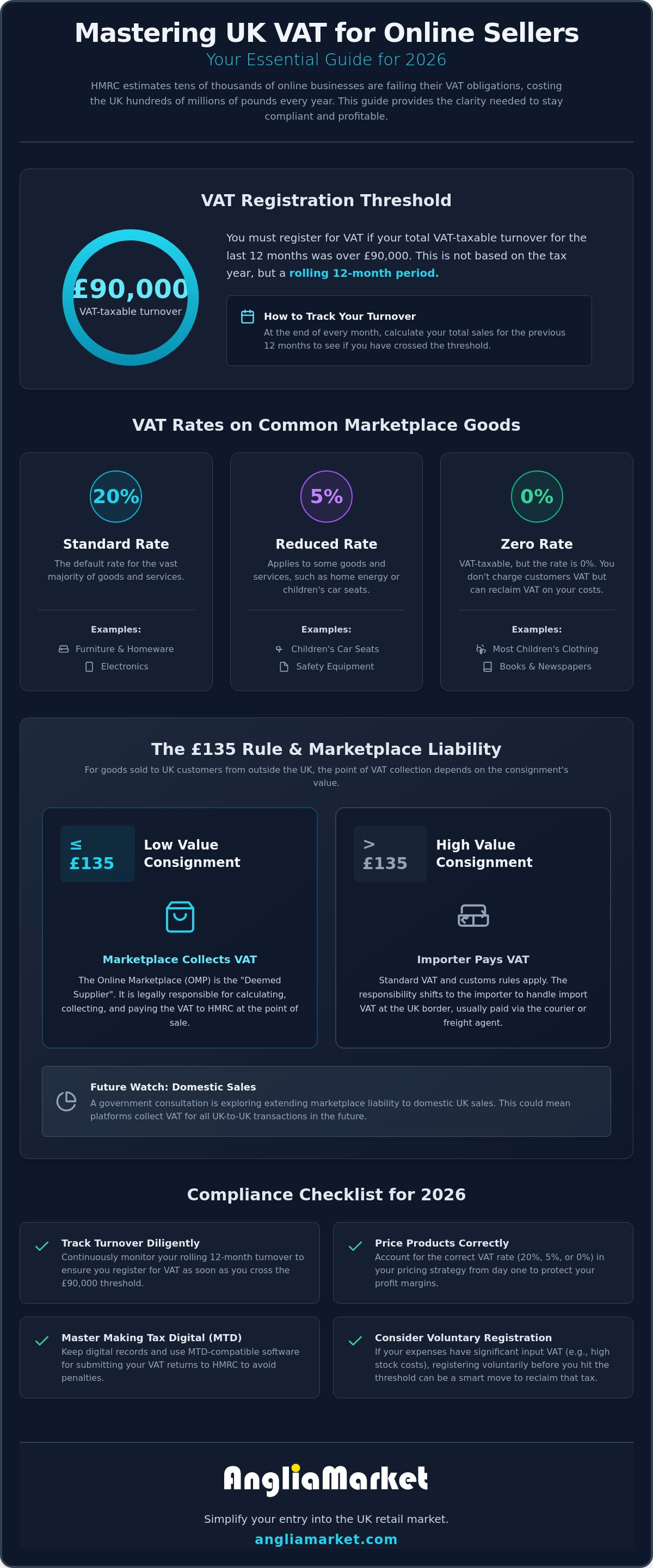
- Understand the current £90,000 registration threshold and how to track your rolling 12-month turnover accurately.
- Learn how the £135 rule shifts VAT collection responsibility and what this means for your marketplace listings.
- Master the rules for vat for online sellers uk to ensure your business remains fully compliant with HMRC in 2026.
- Identify when voluntary registration is a smart commercial move to help you reclaim VAT on business expenses.
- Discover how selling through a supportive platform like Anglia Market simplifies your entry into the UK retail market.
Understanding VAT for Online Sellers: The Basics
Value Added Tax is a consumption tax. It's applied to most goods and services bought and sold in the UK. When you start an e-commerce business, you essentially act as a tax collector for the government. You charge the tax at the point of sale and pass it on to HMRC. This UK Value-Added Tax (VAT) system ensures that the tax burden falls on the final consumer, rather than the business owner. It's a fundamental part of the commercial landscape that every seller must grasp to stay profitable.
You'll deal with two main types of tax: Output and Input. Output VAT is the tax you add to your sales price. Input VAT is the tax you pay when you buy stock, packaging, or services for your business. If you're registered, you pay HMRC the difference between your output and input tax. If you've paid more than you've collected, you can often reclaim the balance. This is a significant benefit for growing brands that invest heavily in inventory.
Mastering vat for online sellers uk is vital for your pricing strategy. If you don't account for a 20% tax hit when setting your retail prices, your profit margins will vanish instantly. You need to know exactly which rate applies to your products before you list them on any platform. Pricing errors are difficult to fix once a sale is made, and HMRC won't accept "confusion" as an excuse for underpayment.
VAT Categories for Common Marketplace Goods
Most items sold online fall under the standard 20% rate. This includes high-demand categories like furniture and electronics. If you're selling a dining table or a smartphone, you must apply the full 20% charge. Most home and garden supplies also carry this standard rate. It's the default for the vast majority of retail goods.
However, some goods have different rules. Children's clothing and most books are zero-rated (0%). This means you don't charge VAT, but you can still reclaim the tax on your business expenses. Other items, like children's car seats or certain safety equipment, fall under the reduced rate of 5%. Knowing these distinctions prevents you from overcharging your customers or creating a tax debt you can't afford to pay.
The Role of the Online Marketplace (OMP)
An Online Marketplace (OMP) is a digital platform that facilitates the sale of goods between a buyer and a third-party seller. In 2026, HMRC defines an OMP as any platform that sets the terms and conditions of the sale and handles the payment process. Selling on your own website means you're solely responsible for all tax calculations and reporting. It's a heavy administrative load for a solo entrepreneur.
Using a third-party platform changes the dynamic. Platforms like Anglia Market provide the essential infrastructure for UK-based vendors to reach a wider audience. Whilst the marketplace helps facilitate a safe commercial environment, you must still understand your specific registration duties. This partnership allows independent enterprises to focus on sourcing great products while staying within the legal framework of the UK tax system.
The £135 Rule and Marketplace VAT Liability
In 2021 and 2022, the UK government fundamentally changed how tax is collected for digital sales. These VAT rules for online marketplaces shifted the burden from small individual sellers to the platforms themselves in specific scenarios. This is known as the "Deemed Supplier" rule. It means the platform is treated as the seller for VAT purposes, even if you own the stock. For consignments valued at £135 or less coming from outside the UK, the marketplace must charge and account for the tax. If the value exceeds £135, the responsibility usually moves to the importer at the point of entry.
For domestic UK sellers, the responsibility currently stays with you, provided you're registered. However, a government consultation running until 18 August 2026 is exploring extending this liability to UK-based sellers too. This could mean platforms take over tax collection for all domestic transactions in the near future. Keeping up with vat for online sellers uk requires watching these legislative shifts closely. If the marketplace is the deemed supplier, the transaction is split into two. You sell to the platform (VAT-free), and the platform sells to the customer (with VAT).
When the Marketplace Collects VAT for You
If you're an overseas seller using a UK warehouse, or a UK seller importing low-value goods, the platform often handles the tax. This simplifies your accounting but affects your immediate cash flow. The platform deducts the 20% VAT before sending you the remaining funds. You must ensure your pricing accounts for this deduction to maintain your profit. If you want to simplify your operations, you can sell online with a platform that understands these regional requirements.
Check your status using this checklist:
- Are the goods located outside the UK at the time of sale?
- Is the total consignment value £135 or less?
- Are you an overseas business selling through a UK fulfillment centre?
Overseas Goods vs Domestic UK Stock
The physical location of your inventory at the point of sale is the decider. If your stock is already in a UK warehouse, the tax treatment is different than if it's shipped from abroad. For UK sellers using drop-shipping from outside the country, this creates a complex layer. You must clearly mark the stock location in your listings. Failure to disclose the correct location can lead to unexpected customs charges for your customers. It can also trigger HMRC penalties for you. If you ship from within the UK, you maintain more control over the tax process. Always verify where your suppliers are actually holding the stock to avoid surprises.
VAT Registration Thresholds and Choosing a Scheme
The current VAT registration threshold for 2026 is £90,000. This figure is not based on your fixed tax year or a calendar year. It's calculated on a rolling 12-month period. You must monitor your turnover every single month to ensure you don't slip over the limit. If you expect your taxable sales to cross this threshold in the next 30 days alone, you're also required to register. HMRC monitors these figures closely. Some businesses try "threshold splitting" by opening multiple small shops to stay under the limit. This is a high-risk strategy. HMRC treats these as a single entity if they share the same equipment, stock, or bank accounts. Penalties for artificial separation are severe and often backdated.
Voluntary registration is often a smart commercial move for smaller businesses. If you spend significant amounts on stock, packaging, or digital tools, being registered allows you to reclaim that tax. It also positions your brand as a professional enterprise when dealing with larger suppliers. Once you hit the mandatory limit, you have exactly 30 days to notify HMRC. Missing this deadline results in a backdated tax bill. You'll have to pay the tax on all sales made since you should have registered, even if you didn't charge your customers for it at the time.
Mastering vat for online sellers uk means picking the right reporting method for your specific business model. The choice you make impacts your daily admin and your final profit. You must ensure your record-keeping aligns with the official Making Tax Digital for VAT guidance to avoid filing errors.
Standard Accounting vs the Flat Rate Scheme
Standard accounting is the most popular choice for retail. You pay 20% on your sales and deduct the tax you paid on business expenses. For sellers of pet supplies or other physical goods with clear overheads, this usually offers the best financial return. The Flat Rate Scheme allows you to pay a fixed percentage of your gross turnover instead. It's simpler to manage but can be more expensive. If you're a "Limited Cost Trader"—meaning you spend very little on physical stock—your rate jumps to 16.5%. This high rate removes almost all the benefits for most marketplace vendors.
The Cash Accounting Scheme for Marketplace Cashflow
Managing cash flow is a primary concern for SMEs on Anglia Market. Standard VAT rules require you to pay tax based on the date you sell the item. However, marketplace payouts often take time to reach your bank account. The Cash Accounting Scheme helps by allowing you to account for VAT only when the money actually arrives. This alignment is vital for maintaining liquidity. It ensures you aren't paying tax to HMRC using money that is still sitting in a marketplace holding account.
Compliance in 2026: Making Tax Digital and Record Keeping
By 2026, the digitalisation of the UK tax system is absolute. Making Tax Digital (MTD) is now a mandatory requirement for every VAT-registered business, regardless of turnover size. This means you can no longer submit returns through the old HMRC portal manually. You must use MTD-compatible software that connects directly to HMRC's systems. Staying on top of vat for online sellers uk requires a shift from paper receipts to a fully digital workflow. Digital Links are the unbroken automated connection between sales data and HMRC software. If you are still copying and pasting numbers from a spreadsheet into your tax software, you are technically non-compliant.
HMRC requires you to keep your digital records for at least six years. This isn't just about proving your sales; it's about justifying your reclaims. You must maintain five essential records: a digital VAT account, all sales invoices, purchase invoices for business expenses, import/export documentation, and any debit or credit notes. If you're ever audited, having these organised in a digital archive is your best defence. Preparing for your quarterly return should be a structured process. Start by reconciling your bank transactions every month. Verify that your tax codes are correct for every item sold. Export your marketplace data, and finally, use your software to submit the digital summary to HMRC before the deadline.
Invoicing Requirements for Online Sales
Every VAT invoice you issue must contain specific information to be legally valid. This includes your business name and address, your unique VAT registration number, a clear tax point (the date of supply), and a description of the goods. For retail sales under £250, you can use a "Simplified Invoice" which requires less detail. This is helpful for high-volume sellers of smaller items. You should also keep digital copies of invoices for all business purchases, such as office supplies or packaging. Keeping these organised in folders by tax year makes your end-of-year reporting much faster.
Managing VAT Returns with Marketplace Reports
Extracting data from your seller dashboard is the first step in your quarterly filing. Most platforms provide detailed tax reports that break down sales by region and tax rate. You must reconcile these reports with your bank account to ensure every penny is accounted for. Remember that marketplace fees often include VAT, which you might be able to reclaim if you have a valid invoice from the platform. This reconciliation ensures you aren't overpaying tax on funds that were actually spent on platform commissions. If you want to build your business on a platform that values transparency, you can sell online with Anglia Market today.
Growth and Support: Selling on Anglia Market
Managing vat for online sellers uk is a major task for any growing business. You need a platform that understands these specific regional pressures. Anglia Market simplifies your entry into the UK retail space by providing a stable, transparent environment. We focus on empowering independent enterprises. This means you get a marketplace designed for your success, not just a place to list items. You aren't just another account; you're part of a dedicated community. This support is vital as you scale from a small startup to a VAT-registered brand.
Transparency is the key to maintaining your profit. Our straightforward fee structure helps you calculate your VAT-inclusive margins without guesswork. You'll know your costs upfront. This clarity allows you to set competitive prices while ensuring your tax obligations are covered. Being part of a marketplace that champions UK-based vendors gives you a distinct advantage. You're trading amongst other small and medium enterprises that face the same regulatory landscape. It's a commercial environment built for local growth.
Supportive Tools for Independent Sellers
Technical hurdles shouldn't slow your momentum. Our Freshdesk support centre is available for any platform queries you have. This resource helps you navigate the technical side of selling so you can focus on your inventory. Managing promotions is also easier here. You can adjust pricing for sales whilst remaining tax-compliant across all your listings. We also encourage you to use our loyalty program. This tool helps you build a repeat customer base. A loyal audience provides the steady revenue needed to offset your VAT costs and operational overheads effectively.
Next Steps for New UK Sellers
Navigating vat for online sellers uk is a journey, not a one-time event. Ready to start? The first step is to register as a vendor on our platform. This gives you immediate access to a UK-wide audience. As your business grows and your turnover approaches the £90,000 limit, we always recommend seeking professional tax advice. A qualified accountant can help you fine-tune your reporting as you scale. The UK market is full of opportunity for those who stay compliant and proactive. Start selling today with a platform that truly understands the local landscape. Build your brand with confidence and reach your commercial goals in 2026.
Take Control of Your E-commerce Compliance
Mastering the rules for vat for online sellers uk is a significant milestone for any growing brand. By tracking your £90,000 rolling turnover and adopting Making Tax Digital software early, you protect your business from costly HMRC penalties. Understanding how the £135 rule and marketplace liability affect your margins ensures you stay profitable in a competitive digital landscape. Compliance isn't just about following rules; it's about building a professional foundation that allows your enterprise to scale with confidence.
Choosing the right platform makes this journey much easier. You can join Anglia Market as a seller today and grow your UK business. We provide a supportive platform for UK SMEs with transparent commission-based fees and direct access to a dedicated UK customer base. Our community-focused environment helps you focus on what you do best while navigating the commercial requirements of the UK market. Take the next step for your business and start selling with a partner that values your growth. Success is within reach when you have the right tools and knowledge at your side.
Frequently Asked Questions
Do I need to register for VAT if I sell on an online marketplace?
You must register for VAT if your taxable turnover exceeds £90,000 in any rolling 12-month period. Selling through a marketplace doesn't change this legal requirement. If your sales are below this limit, you can choose to register voluntarily. This allows you to reclaim the tax paid on your business expenses and stock. It also makes your business look more professional to large suppliers and partners.
What is the current VAT registration threshold for 2026?
The VAT registration threshold for 2026 is £90,000. This is calculated on a rolling 12-month basis, meaning you must check your total sales every month rather than waiting for the end of the tax year. You must also register if you expect your turnover to exceed this amount in the next 30 days alone. If your turnover later decreases, you can only deregister once it falls below £88,000.
How does the £135 VAT rule work for UK sellers?
The £135 rule focuses on goods imported into the UK from overseas. For consignments valued at £135 or less, the online marketplace is responsible for collecting and accounting for the VAT at the point of sale. If you're a UK-based seller shipping from domestic stock, you remain responsible for your own VAT. However, you must watch these rules closely if you use international drop-shipping to fulfil your orders.
Can I reclaim VAT on the fees charged by the marketplace?
You can generally reclaim the VAT on marketplace commissions and listing fees if you're VAT-registered. Most platforms provide a monthly tax invoice that details the tax charged on their services. You record this as input tax on your quarterly return to reduce the total amount you owe HMRC. Always ensure your business details on the marketplace match your official VAT certificate to ensure your claims are valid.
What happens if I fail to register for VAT on time?
Failing to register on time results in heavy financial penalties and backdated tax bills. HMRC will demand the tax you should have collected from the moment you crossed the threshold. This is a major risk regarding vat for online sellers uk because you can't usually charge customers retrospectively for that tax. You'll have to pay the full amount out of your own profit margins, which can be devastating for liquidity.
Do I need to send a VAT invoice to every customer?
You aren't legally required to provide a full VAT invoice for every B2C sale under £250 unless the customer asks for one. For sales exceeding £250, a full VAT invoice is mandatory. Many marketplaces now automate this process by generating digital invoices for every transaction. You must keep digital copies of every invoice issued for at least six years to comply with HMRC record-keeping standards and MTD regulations.
How does Making Tax Digital (MTD) affect my quarterly returns?
MTD makes it mandatory to keep digital records and submit your returns through HMRC-compatible software. You can't manually type your figures into the HMRC portal anymore. This creates an automated digital link between your marketplace sales data and your tax return. Managing vat for online sellers uk now requires a digital-first workflow. This reduces human error and ensures your records are always ready for an inspection or audit if required.
Is it better to use the Flat Rate Scheme for online selling?
The Flat Rate Scheme is simpler but rarely better for sellers with high stock costs. You pay a fixed percentage of your turnover but lose the ability to reclaim VAT on most business purchases. If you sell physical goods and pay 20% VAT to your suppliers, the Standard Accounting Scheme usually leaves you with higher profit margins. Most retail vendors find that the tax reclaims on inventory far outweigh the simplicity of a flat rate.

Here to help — ask anything
If you have any questions regarding this disclaimer or any of our policies, please contact Anglia Market through the contact page on our website, by email using the address provided on the site, or by phone at 0333 772 2593